Skip to content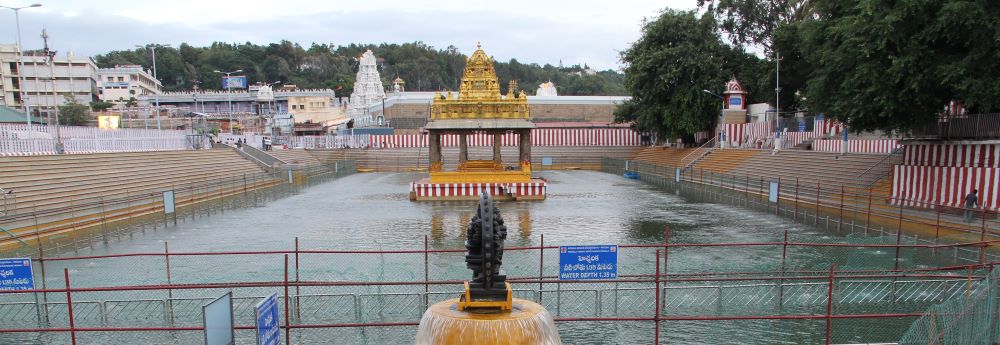
Varaha Jayanti 2025
Tirumala is not just the sacred dwelling place of Lord Venkateswara; it is a timeless spiritual epicentre, revered for its immense divine energy, holy traditions, and deeply embedded mystical heritage.
Varaha Jayanti on 25.08.2025
From ancient times, this hallowed land has been considered a powerful seat of celestial presence, where various forms of divinity are believed to manifest and bless devotees. While Lord Venkateswara is the principal deity enshrined and worshipped in the famed Tirumala temple, the spiritual protocol of this sacred region places Lord Varaha Swamy as the original and presiding guardian deity of the Tirumala hills.
Varaha Kshetra
According to age-old tradition and scriptures, it is Lord Varaha Swamy who is first worshipped by devotees even before offering prayers to Lord Venkateswara. This ancient Vaishnavite belief emphasises that Varaha Swamy is the primordial protector of Tirumala, and as a mark of this reverence, the hills themselves are referred to as “Varaha Kshetra.”
Spiritually, the significance of Lord Varaha is profound— He represents the divine force that rescues the Earth from ignorance and chaos, establishing dharma and order. Devotees believe that offering prayers to Lord Varaha bestows not only blessings for worldly wellbeing but also spiritual advancement and liberation.
Nestled within the sacred premises of Tirumala is the Sri Varaha Swamy Temple, also known as the Bhoo Varaha Swamy Temple, dedicated to Lord Varaha—the third incarnation of Lord Vishnu from the Dashavatara (ten principal avatars). This temple is located on the northern bank of Swami Pushkarini, the holy temple tank believed to have celestial origins. According to tradition, Swami Pushkarini was brought down from Vaikuntha by Garuda on the command of Lord Varaha Himself, making the waters supremely sacred.
The Sri Varaha Swamy Temple is believed to be more ancient than the renowned Sri Venkateswara Temple. This reinforces the deep-rooted tradition that no pilgrimage to Tirumala is considered complete without first worshipping Lord Varaha Swamy. It is customary for pilgrims to take a ritual bath in the sacred waters of Swami Pushkarini, perform prescribed offerings, and then proceed to have darshan of Lord Varaha Swamy.
Only after this sequence of spiritual observance is fulfilled do devotees ascend the steps of the Sri Venkateswara Temple, thereby honouring the sanctified order of worship in Tirumala Kshetra.
This ancient tradition is not merely a ritualistic sequence—it carries deep spiritual symbolism. By bathing in Swami Pushkarini and worshipping Lord Varaha first, the devotee purifies both body and mind, seeks the blessings of the guardian deity of the hills, and only then becomes spiritually prepared to behold the majestic presence of Lord Venkateswara.
Thus, the Varaha Swamy Temple is not just a preliminary stop in the pilgrimage; it is an integral and sanctified part of the Tirumala spiritual journey, holding within its sanctum the eternal message of dharma, divine protection, and the Lord’s unbounded compassion.
History
As per the myth, after rescuing Earth from Hiranyaksha, Lord Varaha stayed on this mountain on the northern bank of Swami Pushkarini. As a result, Tirumala Hills is known as Adivarahakshetra. At the beginning of the Kaliyuga, Lord Varaha granted Lord Venkateswara’s request and handed him the territory.
Lord Venkateswara bestowed the gift of the first darshan and the first naivedyam upon Sri Varahaswami, a privilege granted by the Lord as a gesture of gratitude.
As mentioned in the book of Brahma Purana, before visiting the Sri Venkateswara Temple, pilgrims should first offer naivedyam to Sri Adi Varaha Swami.
3 different ways are used to worship the Varaha Avatara, according to the Atri Samhita (Samurtarchanadhikara) –
- Adi Varaha,
- Pralaya Varaha and
- Yajna Varaha.
Vallabha Pillar
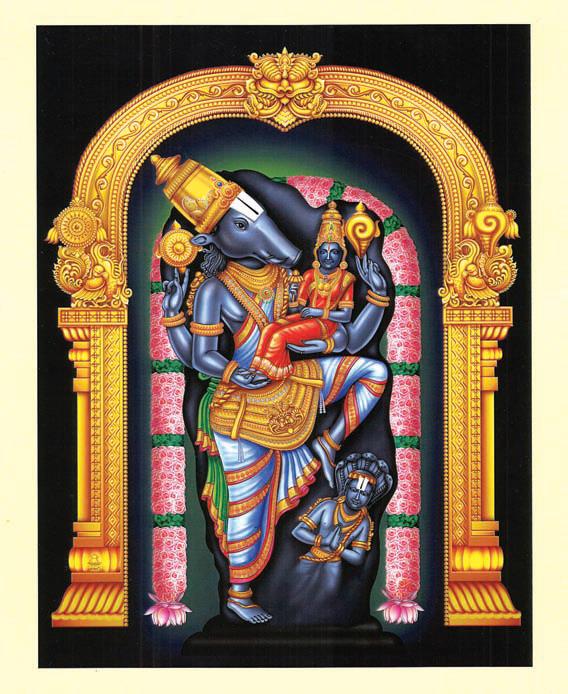
To save Bhu Devi from the demon Hiranyaksha, Lord Vishnu took on the form of a boar. Lord Venkateswara stayed on this hill with Bhuvaraha Swami’s permission. The Vallabha pillar shows the idol Sri Varaha Swami embracing Bhu Devi in his arms while standing on one leg.
Varaha Pushkarini (Swami Pushkarini)
The sacred Pushkarini located in Venkatadri is not man-made; it is considered svayambhu (self-manifested). The title “Swami Pushkarini” is attributed uniquely to this holy pond. Its original name is Varaha Pushkarini. Several ancient scriptures, including the Varaha, Markandeya, Vamana, Skanda, Brahma, and Bhavishyottara Puranas, describe the glory of this divine water body.
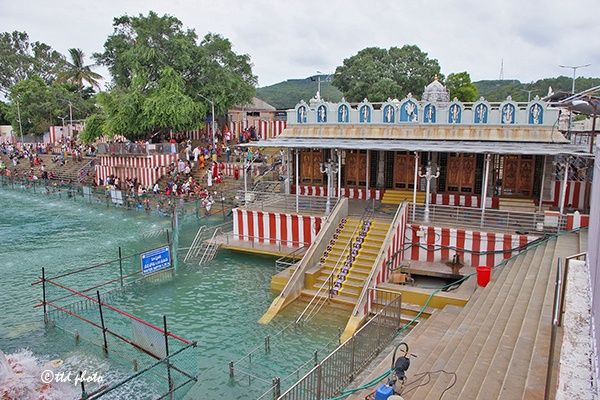
Swami Pushkarini is regarded as the origin of all the three crore tirthas (sacred water bodies) located in the Venkatachala hills. It is said in the Varaha Purana that this Pushkarini, imbued with divine radiance and fragrant waters, manifested even before Lord Srinivasa incarnated on Venkatachala. It is believed to be the source of all sacred waters (sarva tirtha sthanam).
9 holy tirthas
Since Lord Varaha resides on the banks of this Pushkarini, and as Garuda is said to have brought this pond from Vaikuntha on His command, it came to be known as “Varaha Pushkarini”. This sacred Pushkarini houses 9 holy tirthas: Kubera Tirtha, Galava Tirtha, Markandeya Tirtha, Agni Tirtha, Yama Tirtha, Vasishta Tirtha, Varuna Tirtha, Vayu Tirtha, and Saraswati Tirtha.
Devotees believe that bathing in all nine tirthas on a single day and then having darshan of the Lord on the banks of Swami Pushkarini bestows moksha (liberation).
Significance of the Varaha Avatar
The incarnation of the Supreme Being (Parabrahman) in the form of an animal delivers a profound message to humanity. It aligns with the Upanishadic principle that “it is not the form, but the soul that is eternal.” The fact that the Lord chose the form of a boar—an animal often considered impure—to rescue the Earth conveys the powerful idea that divinity transcends form and external appearances.
This avatar demonstrates that God can manifest in any form and that divine essence is independent of physical attributes. It also emphasises the fundamental truth that the Lord shows equal compassion and care toward all living beings.
Another deeper meaning of the Varaha avatar lies in the protection of Dharma (righteousness). The abduction of the Earth symbolizes the decline of righteousness upon it. Bhudevi (Mother Earth) should not merely be seen as soil, but as the embodiment of truth, morality, and the sustainer of life.
By rescuing the Earth, Varaha Swamy sends the message that life must once again be guided by the path of Dharma. In essence, the Varaha avatar stands as a living example of how, in every age, the Supreme Being incarnates in some form to restore righteousness.
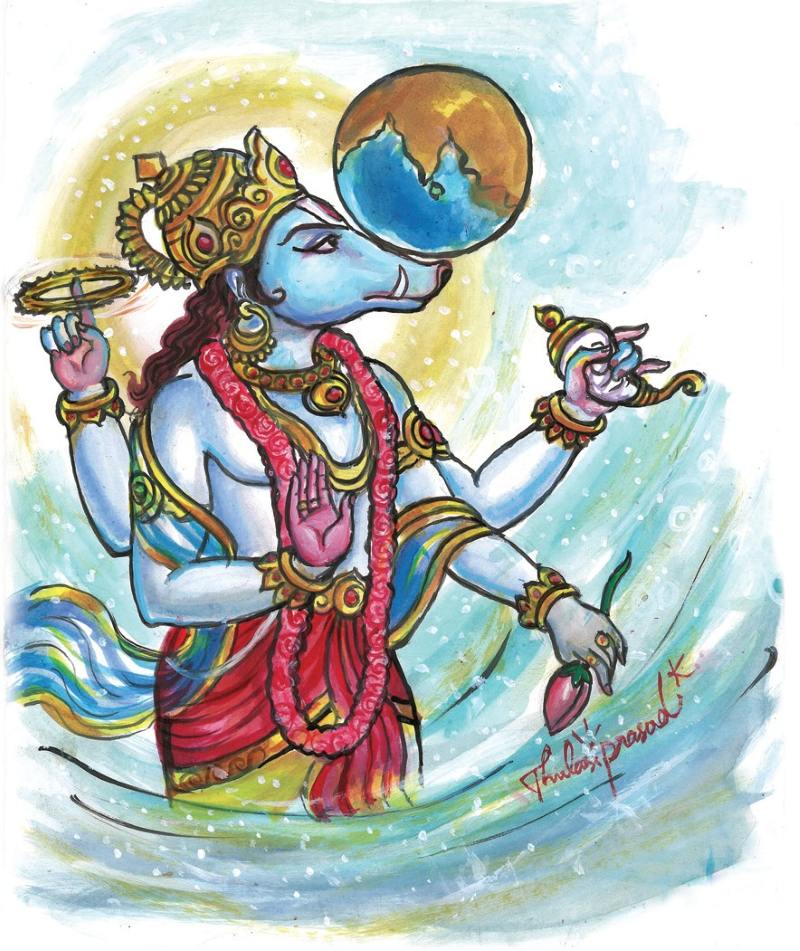
Another notable aspect is that the demon Hiranyaksha symbolises human ego. His act of pulling the Earth down into the depths represents the arrogant desire to control and possess. This same trait is evident in today’s world through the destruction of nature and the selfish exploitation of natural resources. In response to such ego and arrogance, the Lord incarnated as Varaha. When interpreted in the context of the modern age, the Varaha avatar stands as a powerful symbol inspiring environmental protection and the preservation of life. The Vedas and Upanishads also elaborate on the deeper meaning of this avatar.
Texts like the Yajurveda and the Shvetashvatara Upanishad describe the Varaha incarnation as the divine force capable of bringing to light the hidden divinity within nature. Philosophers interpret the Varaha avatar as the form of the Supreme Being who descends in the form of knowledge to awaken the individual soul (jivaatma) when it has fallen into the depths of ignorance (symbolised by Paathaala). The Varaha, who shows the way to the Earth, thus represents the divine consciousness that dispels ignorance and bestows enlightenment.
Ultimately, the essence of the Varaha avatar lies not only in the restoration of dharma in human society, but also in the eradication of ego, the awakening of reverence toward nature, and the cultivation of broad-mindedness to recognise divine presence in all forms.
This avatar serves as a guiding light equally for the devout follower rooted in tradition and the spiritual seeker exploring deeper truths. In this way, the Varaha avatar communicates to us the principles of divine creation, the importance of protecting life, and the realisation of the Supreme Truth, expressed through multiple humanistic and spiritual dimensions.
The Varaha Avatar teaches the profound philosophy of rescuing souls trapped in the darkness of ignorance and leading them toward the light of wisdom. In this context, the demon Hiranyaksha symbolises ignorance and ego, while Bhudevi (Mother Earth) represents creation, the foundation and refuge for all living beings. Through this divine incarnation, it is believed that the Lord removes the ignorance and suffering of all beings and guides them on the path to liberation (moksha).
Message for Environmental Awareness
The Earth is endowed with abundant natural resources—minerals, metals, and hidden treasures. However, excessive and exploitative use of these resources inevitably leads to destruction. That is why, according to the legend, Mother Earth lost her balance and drifted away. To restore her, Lord Mahavishnu incarnated as Varaha.
Today, a similar scenario is unfolding across the world. Natural gas and oil reserves hidden beneath the ocean floors are being extracted recklessly and unsustainably. Numerous global reports warn that in the next 10 to 20 years, Earth could be left depleted of its essential resources. In such a critical time, it becomes essential for us to recall the story and message of Lord Varaha. It urges us to protect our planet and preserve its natural resources with reverence and responsibility.