Skip to content
Nandalur Sri Sowmyanatha Swamy Temple: Lord Vishnu’s Abode in Kadapa
Sri Maha Vishnu, in his beautiful and graceful form, is worshipped here as Sri Sowmyanatha Swamy, offering protection with his Abhaya Hastam. This temple is known for granting devotees wishes upon completing just nine pradakshinas.
Nandalur is located on the banks of the Bahuda River, about 40 kilometers from Kadapa town on the Kadapa–Tirupati highway in Annamayya District of Andhra Pradesh. In ancient times, this region was ruled by King Nirantara, who had a concubine named Nelanda. To honor her wish, he established a village named ‘Nelandalur’ on the banks of the Bahuda River and gifted it to Brahmins as an Agraharam.
Over time, the name evolved from Nelandalur to Nendalaur and eventually to Nandalur. According to the Mackenzie Manuscripts, “Nanda” also refers to Vishnu, and since Vishnu appeared here as Sowmyanatha, the place came to be known as Nandalur.
Sri Sowmyanatha Swamy Temple at Nandalur has over a thousand years of history and is renowned for its exquisite architectural beauty.
Temple Legend
According to legend, in response to sage Narada’s request, Lord Vishnu began a journey on earth and, upon reaching the Bahuda riverbank, was enchanted by the beauty and serenity of the place. He manifested here in a charming form as Sri Sowmyanatha Swamy. It is believed that Narada himself consecrated the deity and performed the first worship here.
Temple Structure
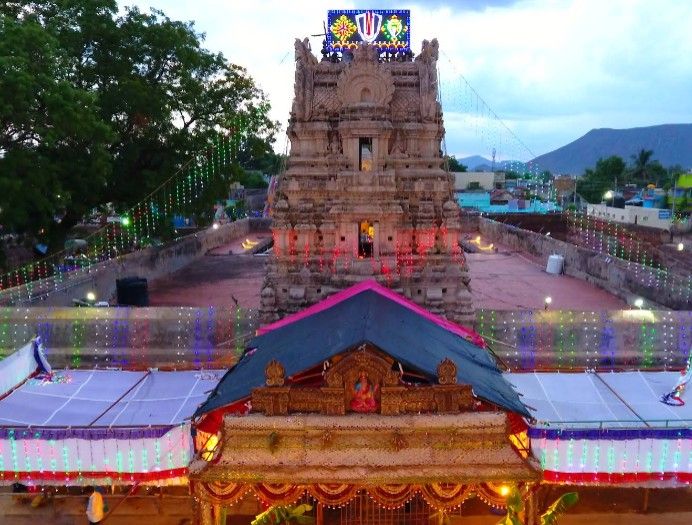
The temple features tall gopurams (gateway towers), majestic entrances, extensive corridors, spacious mandapams (halls), yajna shalas and various deities. There are entrances from the east, north, and south. The eastern gate is the main entrance, adorned with a five-tiered rajagopuram and five kalashas on top. The northern gopuram is three-tiered, while the southern gopuram is now in ruins, leaving only the doorway.
The temple’s pushkarini is to the north of the dhwajastambha, and to its south is a mandapam with an idol of Lord Anjaneya, known as Sri Veeranjaneya Swamy, believed to protect devotees from planetary afflictions. The main sanctum features a three-tiered gopuram above its entrance, through which the deity can be seen directly from outside.
The temple has several mandapams i.e., the Ranga Mandapam, Pradakshina Mandapam, Mukha Mandapam, Antarala Mandapam, and garbhalayam. In the Ranga Mandapam, devotees can worship Sri Narasimha Swamy. Beyond that, there is a wide pradakshina path, followed by steps leading to the Mukha Mandapam, guarded by Jaya and Vijaya on either side. Inside, on the northern side, is Sri Vishwaksena.
Deity of Sri Sowmyanatha Swamy Temple
The main deity, Sri Sowmyanatha Swamy, in Garbhalayam bears a close resemblance to Lord Sri Venkateswara of Tirumala. He is depicted as Chaturbhuja holding a shankha, chakra, kati, and Abhayahastham. The only visible difference is that Lord Sri Venkateswara shows the Varada mudra with his feet visible, inviting devotees to surrender, whereas Sri Sowmyanatha Swamy displays the Abhaya mudra.
He is also called Chokkanatha, meaning “the beautiful one” – “Sowmyanatha ” also implies “the Lord of Soumya Lakshmi.”
On his chest, the idol of Sri Mahalakshmi is present. To his right, there’s a small idol of Anjaneya Swamy, said to have been found by temple priests during early morning rituals by the Bahuda river and then consecrated here. The six-foot-tall idol of Sri Sowmyanatha Swamy shines brilliantly from sunrise to sunset, without any artificial lighting. Even in darkness, the sanctum remains luminously radiant.
This unique construction allows sunlight to fall directly on the deity from a distance of 105 feet from the main door. The temple, built entirely of red stone and supported by 108 pillars, is an architectural marvel. Many divine miracles are attributed to this deity. It is a strong belief among devotees that offering nine pradakshinas with a pure heart while focusing on the Lord fulfills their desires.
Once their wishes are granted, devotees return to offer gratitude by performing 108 pradakshinas. This tradition continues to attract a large number of devotees daily.
History of Sri Sowmyanatha Swamy Temple
Historically, inscriptions reveal that this temple has a legacy of over a thousand years. In the 11th century, Kulottunga Chola (1069–1122) built the temple and donated 120 acres of land. Later, Kakatiya king Prataparudra, who ruled from Warangal, constructed the gopuram and donated five villages to support daily rituals.
Saluva Narasimha Raya of the Vijayanagara Empire, before ascending the throne, served as a commander near Nandalur and later worshipped here as emperor. Not only rulers and emperors, but also many poets, singers, and composers served the Lord here.
The famous Telugu poets, Nannaya, Tikkana, and Errapragada are believed to have visited the temple. Tallapaka Annamacharya, also visited this temple and composed keertanas here. Tallapaka, the birthplace of Annamacharya, is six kilometers from Nandalur. Some of his compositions on Sowmyanatha Swamy include:
Choodanannita Janadu Chokkanadhudu
Veedemichche Naaku Needeevena Chokkanadhudu
Chullara Vettu Jetala Chokkanadhudu
Pullamulo Neladaluru Chokkanadhudu
Sevas
Nandaluru Sri Sowmyanatha Swamy Bramhotsavams will be performed every year in the month of Ashada for ten days apart from daily poojas. During Bramhotsavams different vahana sevas including Rathotsavam and Kalyanotsavam will be performed in a grand style. Besides Bramhotsavams, every year Vaikunta Ekadasi, Dhanur Masa Pujas will be performed.
Though small rest houses are available in Nandalur, it’s often convenient for devotees to travel from nearby towns like Rajampet or Kadapa. Nandalur is 45 km from Kadapa, 10 km from Rajampet, and 95 km from Tirupati. All express trains on the Chennai–Mumbai railway line stop at Nandalur Railway Station.
Temple Location on Google Maps
Final Word
This sacred temple, with its rich history and spiritual significance, offers a divine experience and spiritual fulfillment to all devotees who visit.