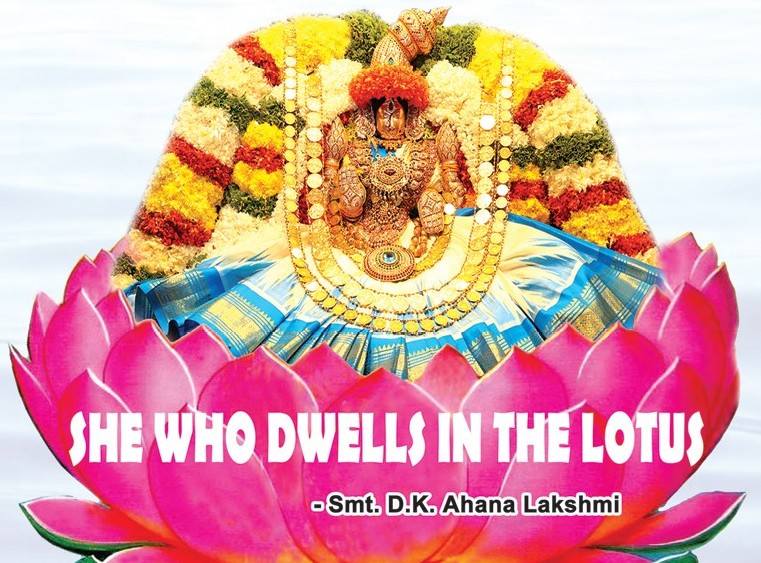
The Divine Story of Sri Padmavati Devi’s Manifestation
King Akasa Raja wanted to perform a yagna. The place he is believed to have ruled from is just about a hundred kilometres from Chennai city, a place called ‘Narayanavanam‘ – the forest of Narayana. When the surface of the land was being cleared using a golden plough in preparation for the yagna, they found a baby.
Padmapriye Padmini padma-haste
padmalaye padmadalayathaakshi
This verse-bit from the Sri Suktam describes it best: fond of lotuses, possessor of lotuses, with lotuses in her hands, lotus-dweller with eyes like lotuses. She was Goddess Padmavati.
The story of the manifestation of Sri Padmavati Devi is narrated by Lord Varaha in Venkatachala Mahatmyam, a part of the Skanda Purana. The largest of the eighteen Mahapuranas, which bears the name of the son of Siva-Parvati, has seven khandas that almost serve as travel guides to different pilgrimage centres.
The second book is the Vaishnavakhanda, whose first section is Venkatachala Mahatmyam. It begins with the sages asking for a description of the prominent mountains on the surface of the earth. This is followed by the narration of what Sri Varaha told Goddess Earth when she asked him about the chief mountains capable of sustaining her. That is when he describes Seshachala’s excellence among all mountains and also mentions that Swami Pushkarini is the best among the tirthas. He dwelt on the western bank, while on its southern bank dwells Srinivasa, the Lord of the Universe.
Moving forward, we come to the section where Lord Varaha expounds the Varaha mantra and then to the section where Goddess Earth, Dharani, asks Sri Varaha when Srinivasa, the Lord of the Universe, comes to Venkata, accompanied by Sri and Bhumi.
This is when we hear about the birth of Akasa to the mighty warrior Mitravarma. It was King Akasa (Akasaraja) ploughing the ground for a yagna who found a beautiful baby nestled in a bed of lotuses. Akasaraja and his queen Dharani delightfully adopted her. Soon, Queen Dharani also gave birth to a son, named Vasudana.
Padmavati grew up, and one day, while she was playing with her friends in a garden, Sage Narada came there by chance. Narada read her palm and was astonished to see signs that indicated her marriage with Lord Vishnu.
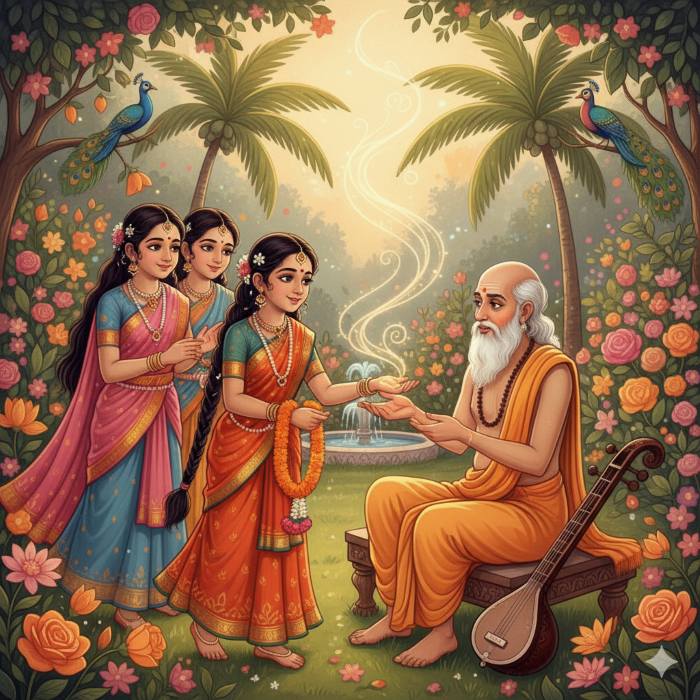
Another day in the garden. It was spring, and a variety of flowers were in bloom. Padmavati and her friends headed there to collect flowers. Suddenly, a dark-complexioned horse rider reined in, claiming he had been chasing a wolf. Padmini angrily asked him to leave as the place was under the protection of King Akasa, and none of the animals were to be killed. He said that he was referred to as the lord of the heroes and resided in Venkatadri. Then he asked her friends if the beautiful lady could become his wife. The friends angrily told him that if King Akasa saw him, he would be taken away and put in prison.
Back home, the young man who was none other than Srinivasa, could not take his mind off the beautiful girl he had seen. When Vakulamalika, a female attendant who brought him food, asked him why he was so thoughtful, He, who was none other than Lord Vishnu, narrated the tale of Vedavati who had impersonated Sita when Ravana tried to abduct her. He then said that he had promised to marry her in the twenty-eighth Kaliyuga when she would be born as the daughter of King Akasa at Narayanavanam. Vakulamalika said that she would go and speak to the king and queen on his behalf.
Meanwhile, Akasaraja had asked his royal astrologer, who said that a lady would come asking for the hand of the King’s daughter for Lord SriHari himself. So, when Vakulamalika went to Narayanavanam and met Queen Dharani and King Akasa, they were very happy and decided to hold the wedding on uttaraphalguni day in Vaishaka month. While this is celebrated as the festival of Sri Padmavathi – Srinivasa Kalyanam in the name of Padmavathi Parinayotsavam every year in May, the temple of Sri Kalyana Venkateswara at Narayanavanam (A.P. State) is one of the few temples where Lord Srinivasa and Padmavathi ammavaru can be worshipped together.
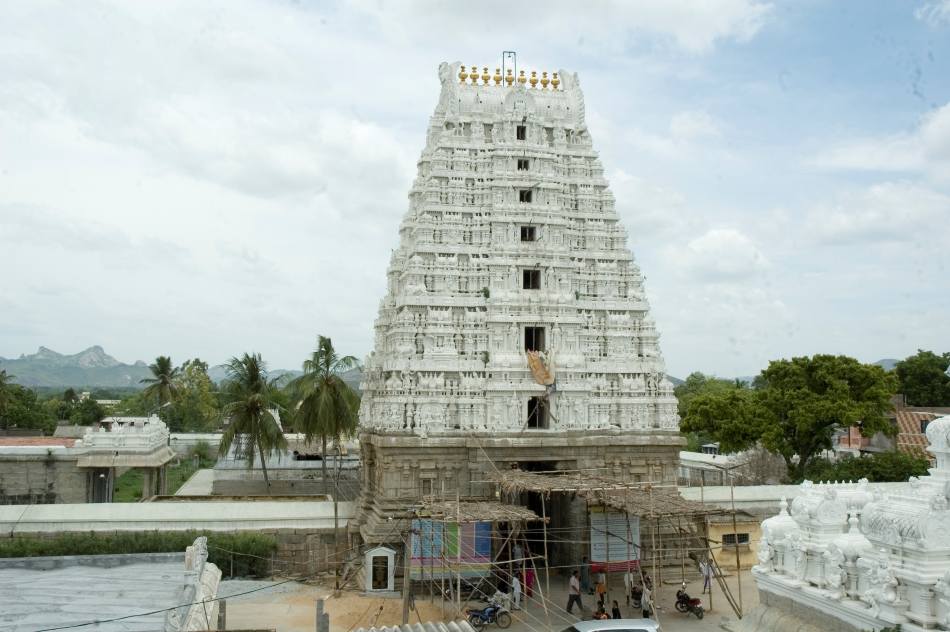
Going back to the description in the Purana, Srinivasa told Vakulamalika the way to Narayanavanam. He described the route that she had to take, first descending the mountain via the cave of Nrusimha, to the hermitage of Agastya and the linga worshipped by him on the banks of Suvarnamukhahari. She would then reach the forest of the sage Suka (which is why Tiruchanur was also called Sri Sukanur) and the banks of the Padmasaras, a pond filled with lotuses.
Later, Padmavati preferred to make her permanent abode at the foothills of Tirumala by the Padmasaras, which is why we can worship her at Tiruchanur. She manifested herself in the month of Kartika on sukla paksha panchami with the Uttarashada star on the ascendant. She is there for all her devotees as she is the universal mother. Hence, her Brahmotsavam is celebrated with great pomp every year during that period.
Vishnupatni Jaganmaatha
Vishnuvakshsthalastite,
Padmasane Padmahaste
Padmavati namostute.
Temple Iconography and Worship
The mula-bera (main presiding deity) of Goddess Padmavati at Tiruchanur presents her in a two-armed sitting form, holding the lotus and displaying boon-bestowing mudras. Her icon reflects both the pan- Indian Silpasastra tradition and the local sthala-purana.
Festivals reinforce these theological motifs. The annual Kartika Brahmotsava, witness during the grand ending with the celebration of Chakra Snanam or Avabruta Snana on Panchami Theertham, enacts her symbolic return to the Padma-sarovara, where devotees receive the highest reverence and feel the sacredness by beholding her presence in the waters of her origin. Daily worship follows the Agamic traditions of Pancharatra, with hymns, Sri Sukta recitation, and Alwar pasurams extolling her inseparability with the Lord.
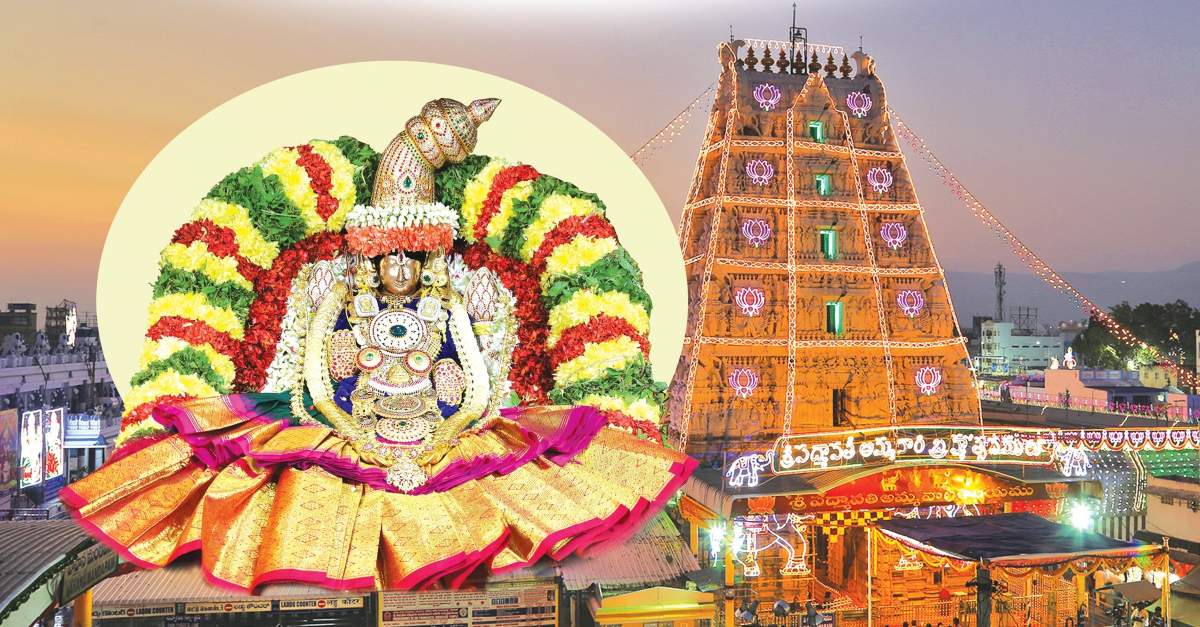
Thus, the worship of Goddess Padmavati at Tiruchanur is not only a local practice but also a lived embodiment of pan-Indian Sri theology, harmonising Vedic hymns, Puranic narratives, Agamic rituals, and Alwar devotion.
From the golden-hued Lakshmi of the Sri Sukta to the lotus-born Sri Padmavati of Tiruchanur, the Goddess manifests across texts, images, and sacred spaces as the eternal consort of Lord Vishnu, the source of prosperity, and the mother of compassion. Her iconography in Silpasastras ensures that the divine truths of scripture are made visible, while her sthala-purana at Tiruchanur affirms the immediacy of her grace to devotees.
To witness Alar Mel Mangai at Tiruchanur is to realise the eternal truth sung by the Alwars and proclaimed in the Puranas: that Goddess Lakshmi is never apart from Lord Narayana, and through her mediation, divine grace flows continuously to the world.