Skip to content
Beyond the Chariots: The Deep Historical Significance of Puri Rath Yatra
Sri Jagannath has been worshipped in the Purushottam kshetra since Satya Yuga. It is known from various Puranas that, in the Satya Yuga, there was a king named Indradyumna. He was a great devotee of Sri Vishnu. Once, he organised a religious assembly in his royal court. He asked the holy ascetics present there where Sri Vishnu could be seen.
At that time, a saint named Jatila arrived there and informed the king that Sri Neelamadhaba, who is worshipped in the Purushottam kshetra, is Sri Vishnu. Hearing this, King Indradyumna sent his royal priest’s brother, Vidyapati, to search for the Purushottam kshetra. Vidyapati arrived in the Udra state, which is now present-day Odisha.
Purushottam Kshetra was ten yojanas wide. A tribal named Vishwavasu used to worship Sri Neelamadhaba in a cave in a dense forest. Every day, the gods visit Sri Neelamadhaba. Vidyapati visited Neelamadhaba with the help of Viswavasu. After the visit, Vidyapati returned to King Indradyumna and told him about Sri Neelamadhaba.
Indradyumna happily came to see Neelamadhaba. However, when Indradyumna arrived at Neelamadhaba, he had already disappeared. The place was completely deserted.
King Indradyumna began to cry in sorrow. At that time, Devarshi Narada addressed Indradyumna and said, “King, don’t worry. There is a Sankha kshetra on the seashore of this Purushottama Kshetra. Which is the most sacred place? God Narayana always resides there with Goddess Lakshmi. You go there and do penance.” Hearing this, King Indradyumna reached the sacred Sankha khetra and first of all had darshan of Sri Nrusimha.
There he worshipped Nrusimha and performed sacrifices for many years. Once he saw a big tree in the Puri sea. He brought the divine tree to the seashore. Devarshi Narada advised that the idol of Narayana should be made from that tree. That tree was Sri Vishnu. King Indradyumna was surprised. The king was wondering how to make an idol from a log. At that time, an old man came and said that he would make an idol from this log. The king made all the arrangements. The old man said that no one would open the construction house until the work was completed.
Every day, there was a sound from the house. But suddenly, one day, there was no sound from the house. Thinking that the old man was unwell, the king opened the door and saw that four idols had been made, namely Jagannath, Balabhadra, Subhadra and Sudarshan. Sridevi, Bhudevi and Madhava, small idols, were also there. But the old man vanished. God himself constructed his idols.
The temple where these statues were built was the Gundicha temple. After making the deity, King Indradyumna built a temple on the Niladri hill, about 3 km away from the Gundicha temple. The deities were taken to that temple in three chariots. At Niladri Hill, Sri Jagannath and other deities were worshipped. That was the first Puri Rath Yatra of Sri Jagannath.
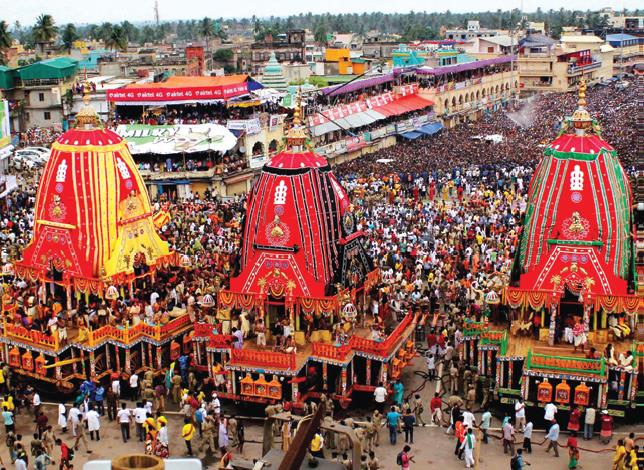
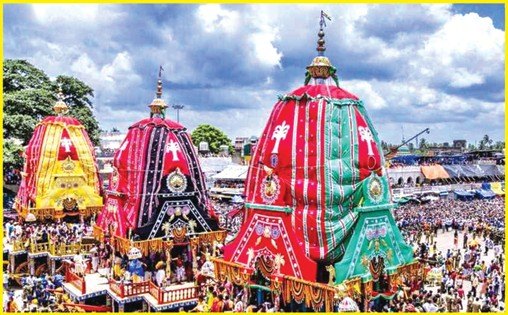
Every year, on the second day of the bright fortnight of the month of Asadha, Sri Jagannath travels to the Gundicha temple along with his elder brother Balabhadra, sister Subhadra and the weapon Sudarsan. Three large chariots are built every year. Jagannath travels in the Nandighosha chariot. Balabhadra travels in the Taldhwaja chariot.
Subhadra travels in the Devdalana chariot. Sudarshan travels in Subhadra’s chariot. The four deities stay in the Gundicha temple until the Bahuda Yatra. Bahuda means return. This Bahuda Yatra is held on the tenth day of the Asadha Shukla month. On this day, the four gods return to the temple of the Niladri hill. The same chariots return to bring the deity again.
The scriptures say that just as the Sun-god travels around the world every day on a chariot, Sri Jagannath travels around the world on a chariot. Sri Jagannath is not only the god of humans but also of all living beings in the world. Therefore, to give darshan to all living beings, regardless of caste, religion, color and gender He comes to the devotees once a year.
Bada Danda
The road on which Jagannath’s chariot goes from Sri Mandira to the Gundicha Mandira is called Bada Danda. Bada means big. Danda means road. Since that road is very big, it is called Bada Danda. When Sri Jagannath is on the chariot, He becomes Vamana avatara of Sri Vishnu. Scripture says that a person who sees Jagannath on His chariot once in a lifetime is never reborn again. Therefore it is said – Rathe tu Vamanao drustwa punarjanma na vidyate.
Many famous saints, including Adi Shankaracharya, Sri Ramanujacharya etc., have meditated here. Adi Shankaracharya established four monasteries in the four directions of India. Out of these, Govardhan Peetha was established in Puri for the east direction.
Construction of chariots
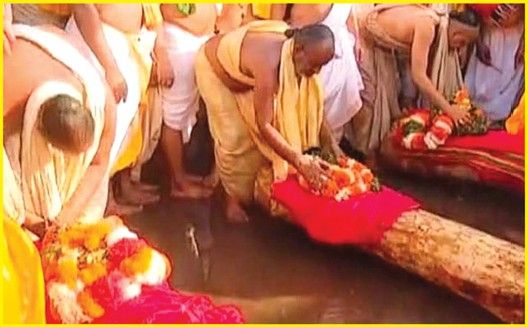
Puri Rath Yatra is not just a one-day festival. This festival is held for about a month, especially from the Jyestha Purnima to the Asadha Purnima. Since new chariots are being built every year, the cutting of the wood for the Puri Rath Yatra is done at an auspicious time. Wood is brought from the Dasapalla forest, about 120 km from Puri. Here, the goddess Gada Rahula is first worshipped, and the wood is cut.
After this, the wood is brought to the palace of the Puri king, which is near to the Singha dwar of Jagannath temple. The construction of the chariot begins under the direct supervision of the king and the government of Odisha. Various types of craftsmen are involved in the construction of this chariot.
After the arrival of the chariot wood, Puja Panda sevaks, Vedic Brahmins of Mukti Mandap and other sevakas worshipped the auspicious wood on the day of Vasant Panchami or Saraswati Puja. After the garlands of Jagannath, Balabhadra, and Subhadra come from the temple, three pieces of wood are worshipped for the three chariots.
Starting from Sri Ram Navami, wood is cut in a saw mill. Then, on the day of Akshyaya Trutiya, the chariot construction begins. After the Puja on Akshyaya Trutiya, the Maharana (Carpenter) sevakas devote themselves to the work of the chariot. The chariot is built every day with the dedicated service of various craftsmen.
The construction of the chariot is completed on the day before the Puri Rath Yatra. 862 wood logs are used every year to build chariots.
Snana Purnima
An important festival of the Rath Yatra is Snana Purnima. On this day, the four deities come down from the place where they sit. That is called Ratna Singhasana. They come to the Snana mandapa. Snanan mandapa means birth mandap. This festival is celebrated every year on the full moon day of the Jyestha month.
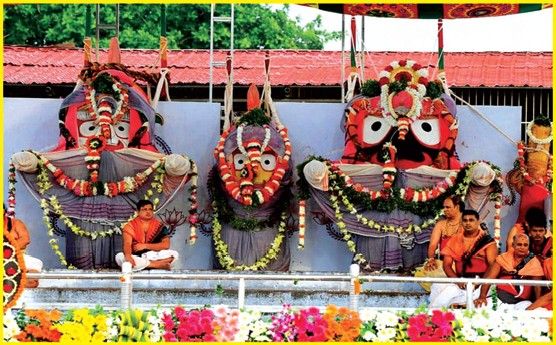
Every day, the wooden idol is bathed inside the temple through a mirror, but on this day, Sri Jagannath, Balabhadra, Subhadra and Sudarshan are bathed in 108 pots of fragrant water. Water comes from the well of the temple premises and the Mahaprabhu bathes in that holy water. That night, Sri Jagannath and other deities gave darshan to the devotees in the form of Ganapati.
Anasara Niti
The god gets a fever after bathing. Therefore, from Jyestha Pratipada to Jyestha Amavasya, Mahaprabhu does not give darshan to the devotees. At that time, the Daitapati and Vidyapati sevaks only served Mahaprabhu in the anasara house inside the temple.
At that time, God is offered only fruits and juice. To cure the fever, Ayurveda medicine is given. Many secret rituals are performed at this time. Cloth printed God worshipped outside near the door of Garuda sthamba. God Narayana is worshipped instead of Jagannath. God Vasudeva was worshipped instead of Balabhadra, and Goddess Bhuvaneswari was worshipped instead of Subhadra.
Nava Yauvana Darshan
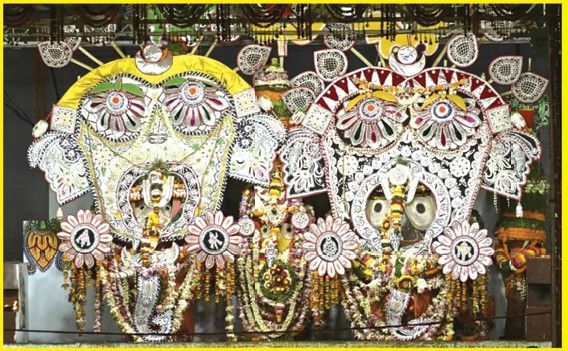
On the second day of Jyestha Amavasya, the deities are seen again. After 15 days, this darshan is called Nava Yauvana Darshan.
Puri Rath Yatra
On the second day of the month of Asadha shukla, Rath Yatra is held. In Puri Rath Yatra, Sri Jagannath, Balabhadra, Subhadra and Sudarshan travel to their birthplace in chariots. On this day, the chariot is worshipped in the morning by Vedic Brahmins. A special feature of this yatra is the Pahandi Bije.
The four Deities are specially tied to velvet cloth and carried to the chariot in procession. At this time, the music of bells, kahali, mridangas, etc., is very beautiful. The monks of the monastery have various services in front of the Gods.
Odishi dance by an Odishi dancer performed in front of God. The incumbent of the Puri Govardhan Peetha, established by Adi Shankaracharya, comes and worships the Gods. After this, the Gajapati King of Puri worships.

First, he cleans the chariot with a golden broom. The chariot is perfumed with sandalwood water. Then the king offers Camphor Arathi. After this, all three chariots are pulled by devotees from the Sri Mandira to the Gundicha Mandira. The ropes tied to the chariot are pulled by the devotees. It took about four hours to travel by chariot from the Sri mandira to the Gunchicha mandira.
Every year, more than ten lakh devotees assemble at Puri to have darsan of Sri Jagannath. Devotees from many religions and many countries come to witness this divine journey of Lord Sri Jagannath.
Hera Panchami
Sri Jagannath goes on a chariot journey. He takes His elder brother Balabhadra, sister Subhadra and the weapon Sudarshan with him. But he doesn’t take his wife Lakshmi with him. So Goddess Lakshmi is sad. On the bright day of Asadha Shukla Panchami, Goddess Laxmi travels on a viman and goes to the Gundicha temple with her sevakas.
There, she breaks a piece of wood from Jagannath’s Nandighose chariot. The sevaks of Sri Jagannath tell Jagannath that Goddess Lakshmi has broken the chariot in anger. After that, they make all arrangements for the return of Jagannath.
Bahuda Yatra
On the tenth day of the Asadha Shukla, Jagannath returns to the temple with his brother, sister and weapon. Four idols come on the chariot with a special procession called pahandi. Saint Shankaracharya and the Puri Gajapati King worshipped the deities on the chariot. After this, the chariot is pulled by the devotees.
On the way, Jagannath’s aunt’s Goddess Mausi Maa, prepares a special cake for Jagannath. It is worshipped there. Then four deities return in front of the Sri Mandira by evening.
Suna Besha
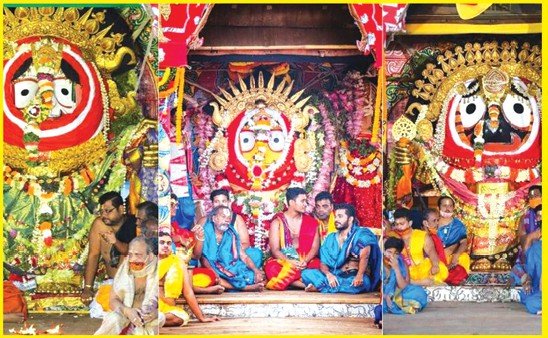
On the Ekadashi tithi of the Asadha shukla, the golden besha of the Gods is performed. This ritual is performed on the chariot. This is called Rajarajeshwar Besha. The four idols are adorned with crowns, garlands, weapons, etc. made of various gold and precious stones. For thousands of years, the gods have been adorned with golden ornaments donated by various kings.
Niladri Bije
On the day after Suna Besha, the deities are taken into the Sri Mandira from chariots. Balabhadra and Subhadra first visit the temple in the pahandi procession. Then, when Sri Jagannath enters the temple, Goddess Lakshmi comes and guards the door. She asks why Jagannath did not take her to such a big car festival. So she does not let him inside.
After that, Jagannath offers rasagolla sweets and breaks the vow of Maha Lakshmi. Then goddess Lakshmi opens the door and Jagannath enters the temple.