A Towering Symbol of Grandeur – Sri Govindaraja Swamy Temple
Sri Govindaraja Swamy temple, located in the heart of Tirupati, was built in the 12th century and was consecrated in the year 1130 by Bhagavad Ramanujacharya. Sri Govindaraja Swamy is considered as the elder brother of Sri Venkateswara of Tirumala. According to legends, while the younger brother earns a lot of money by becoming famous as ‘Vaddikasulavadu’, the elder brother is vested with the job of counting the money.
The deity of Govindaraja Swamy can be seen in a reclining (Yoga Nidra) position, which is portrayed as the Lord getting tired of counting the money and going to sleep by keeping the bag containing gold coins under his head.
The appearance day of Sri Govindaraja Swamy is celebrated on Uttara star of Phalguna month. The shloka that defines his appearance is as follows: ‘Phalguna Mase Poornayam Uttarakshenduvasare Govindarajobhagavan Praduraaseeth Mahamune’. This verse is recited during major festivals and occasions at the temple.
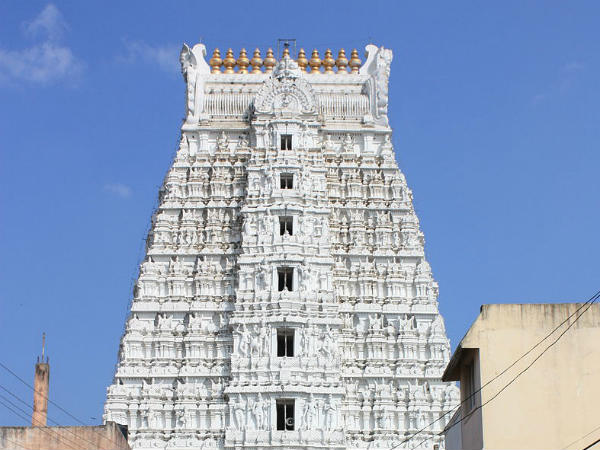
The temple was developed in phases during the regnal period of various empires. However, the main Gopuram, which is said to be the tallest among the TTD temples, was built by the Matli Kings, who ruled from Matli near Rayachoti as the capital.
The Matli chiefs belonged to the Devachoda family, who assumed prominence when the Vijayanagara empire was at its zenith. They maintained equal stature with the Vijayanagara rulers. Matla Anantaraja, a local chieftain, developed the temple in phases. He was succeeded by his son Tiruvengalanatha and grandson Kumara Ananta, who also contributed to the glory of the temple.
According to inscriptions, Kumara Ananta was responsible for the construction of the big outer Gopuram, having seven storeys (measuring 50 metres in height) and the second Gopuram at the foot of Tirumala hills, called as the Kotha Gopuram. Towards the west of this mammoth Gopuram is the main entrance with a smaller Gopuram. There are Sannidhis for Sri Parthasarathy, Sri Pundareekavalli Ammavaru, Sri Andal Annavaru and Sri Kalyana Venkateswara, besides Chakrathalwar, Lakshmi Narayana, Anjaneya, Ramanuja and Tirumala Nambi.
Pundareekavalli Ammavaru
The spouse of Govindaraja Swamy is called Pundareekavalli Ammavaru. The special character of this Goddess is that She never steps out of her house (temple), but truly enjoys her life in the service of Her husband. This is why the processions for the Goddess are taken within the precincts of the temple and not taken on the Mada Streets around the temple.
Brahmotsavam is generally performed for nine days, but the Varshika Utsavam for Ammavaru is performed only for seven days. The festival is conducted in such a way as to coincide with the Uttara star of the Tamil Panguni month.
Panguni Uttara day marks the wedding of the Lord and Goddess in most of the temples in India. The day is dedicated to the divine wedding, and as such, the Brahmotsavam for Goddess Pundareekavalli coincides with Her wedding.
During Her Brahmotsavam, the deity is taken in a procession around the second Gopuram, where the Goddess makes an ‘Abhimana Pradakshinam’ for three times around the Sannidhi of her spouse Sri Govindaraja which is portrayed as going around the spouse with a feeling of affection. Then the deity is kept on a swing and rocked to and fro. The Goddess enjoys Veda, Nada and Vaayidhya Seva, when Vedic scholars chant hymns, classical singers recite compositions and instrumentalists perform a concert.
Divya Prabandha Pasurams, composed by Alwars, are chanted on all seven days. During the annual Brahmotsavam of Ammavaru, it is a practice to chant verses from ‘Tiruvoimozhi’ composed by Saint Nammalwar. On the last evening, i.e., Panguni Uttara, the deity of Govindaraja Swamy is brought to the Sannidhi of Pundareekavalli Ammavaru.
Pranaya Kalaham
The door is shut in a peculiar way to deny entry to Sri Govindaraja Swamy inside the Sannidhi and then opened again. This is performed as a form of ‘Pranaya Kalaham’ (Premapu Jagadam). Then the Goddess forgives the Lord and allows Him into her Sannidhi, where both the deities are placed on a single Simhasanam.
‘Venchepu’ and ‘Sathumora’ are performed to the deities and the Swami’s floral garland is adorned to the Goddess.
Click here to explore – Ponnakalva Utsavam
Saalai Nachiyar Utsavam
The Panguni Uttara Utsavam is also called as ‘Saalai Nachiyar Utsavam’ as per TTD Panchangam. Saalai means godown and there used to be a godown in front of Pundareekavalli Ammavari Sannidhi in the past. It was hence referred to by the name, which continues even today.
Khanija Thototsavam
This is another summer-related event performed for Sri Govindaraja Swamy to beat the heat. There is a step well in the Old Huzur Office building located directly behind the temple, which housed the TTD’s administrative headquarters in the past. The Utsavam is performed in June, after the completion of the annual Brahmotsavams at the temple.
The deities of Sri Govindaraja Swamy and His consorts Sridevi and Bhudevi are taken in a procession from the temple to the Old Huzur Office building via South Mada Street in a clockwise direction. They are further taken down the step well, where Snapana Tirumanjanam is performed in a grand manner with the water brought from the well.
In the evening, Asthanam is performed and the deities are once again taken back to the temple via North Mada Street, following the principle of carrying deities in a clockwise direction.
Parveta Utsavam
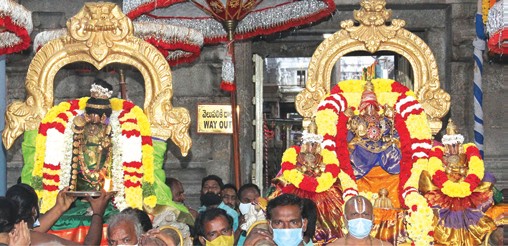
Parveta Utsavam is a form of mock hunting, which is observed as the Lord’s favourite pastime. Parveta Utsavam is conducted twice a year in the Sri Govindaraja Swamy temple, once during Kanuma (January) and the other during the Vijayadasami festival (October). The first Parveta is taken out on the Kanuma festival.
After Kalyanam is performed grandly to Sri Krishna and Godha Devi on the Sankranti Day, which marks the end of Dhanurmasam, the Parveta is taken out on the next day, i.e., Kanuma. The deities of Govindaraja Swamy and His consorts are taken out from the temple to the Parveta Mandapam on Renigunta Road, where Asthanam is performed.
This Parveta is treated as a festival-eve outing. Later, the deities are brought back to the temple by evening.
On Vijayadasami day, the deity of Govindaraja Swamy is taken on Aswa Vahanam, as if the Lord goes hunting on a horse. The procession reaches the Parveta Mandapam, where the bow and arrows are aimed by the priests, symbolising mock hunting.
Today, Sri Govindaraja Swamy temple is not just a major landmark in Tirupati, it is also a towering symbol of grandeur, a representation of cultural richness and a grand tribute to Sri Ramanujacharya’s efforts in establishing Sri Vaishnavite thought. Participate in the Brahmotsavams and be blessed.